
Make your idea move
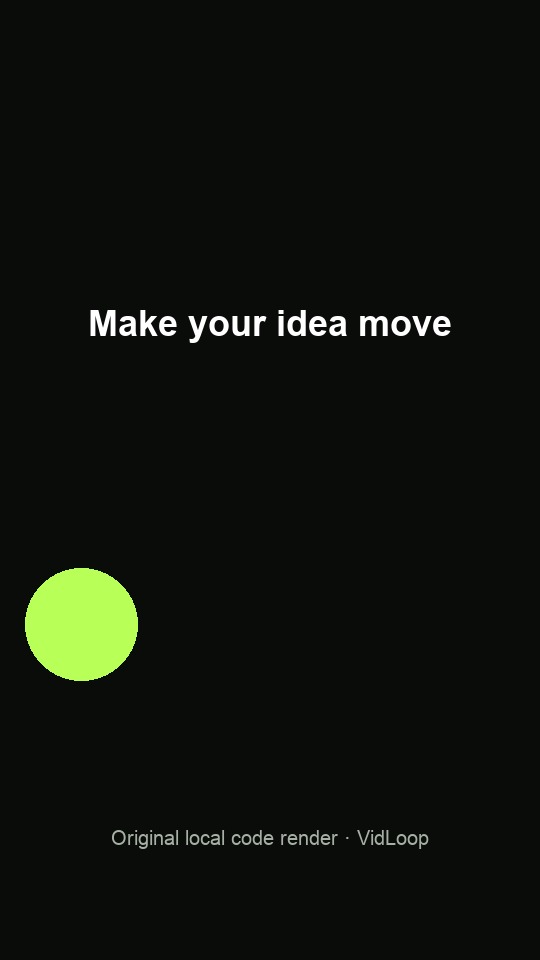
A six-second silent motion graphic rendered from code. A lime circle moves across a black scene under an editable title. This is a local render, not an Opus-generated MP4.
Local deterministic renderer · 540 × 960
Original ideas. Real video workflows.
An Opus 5.5 video workflow uses Claude to plan or write code, then a renderer turns that code into frames. Claude’s documented outputs include text and code. Try the local motion-graphics renderer below, or generate new realistic footage in the separate VidLoop workbench.
This page does not call the Claude API. The preview and WebM export are generated locally from your text; the sample is an original deterministic render.
Edit a heading and subtitle, preview the animated scene and export a WebM in a browser that supports canvas recording. Download the brief to continue in Claude or your renderer.
Preview and export a six-second silent animation locally.
Play the original output and inspect the actual model, duration and prompt. The examples are fictional creative scenes made for this guide.
A six-second silent motion graphic rendered from code. A lime circle moves across a black scene under an editable title. This is a local render, not an Opus-generated MP4.
Local deterministic renderer · 540 × 960
Opus 5.5 video workflows can use Claude-written code or a production plan with a separate renderer. Anthropic documents text and code outputs. Distinguish planning, rendering and encoding before choosing a tool; a code response alone is not a downloadable video.
Use this workflowPlan an Opus 5.5 video animation with clear dimensions, duration, title, background and movement. This local studio records a six-second canvas animation as WebM. Edit your title and color, preview the result, then render. The renderer runs in your browser without invoking Claude’s API.
Use this workflowFor repeatable Opus 5.5 video timing, describe positions and frame transitions explicitly. Save the downloadable brief for a coding workflow, or export this working local animation. Its sample is labeled as a code render, with actual duration and dimensions; it is separate from AI-generated footage.
Use this workflowCombine an Opus 5.5 video code layer with realistic footage when your idea needs people or complex environments. Use VidLoop’s separate generator for those visual frames, check its quote and inspect the result. Assemble approved footage with coded titles afterward for predictable text placement and timing.
Use this workflow| Component | What it produces | This page’s implementation |
|---|---|---|
| Claude Opus 5.5 | A brief or rendering code | Official link and downloadable brief |
| Local canvas renderer | Animated frames and WebM | Working preview and export below |
| Video encoder | A packaged video file | WebM locally; MP4 conversion externally |
| VidLoop generator | New realistic visual frames | Separate quoted generation workbench |
Upload clear permitted portraits or a complete scene; keep faces visible, remove overlays. For fictional scenes, select a text preset.
Apply your preset. Review model, mode, duration, quote and balance. MiniMax H3 starter credits fund H3 only; general credits cover other supported models.
Inspect identity, anatomy, movement, camera drift. Revise an instruction responsible for visible errors before download.
Download your reviewed video. Add licensed sound or captions, label synthetic performances, keep source files with generation settings for revisions.
Choose a subscription for regular creation, or a one-time credit pack below. Compare credit quotes by model, duration, resolution and audio. Check out securely with PayPal; monthly plans issue credits each billing period and annual plans release credits monthly.
MiniMax H3 · Member benefit
Every paid plan includes MiniMax H3 credits. A 5-second 768P video uses just 5 credits; a 5-second 2K video uses just 10.
768P
1
credit / sec
2K
2
credits / sec
These rates apply to MiniMax H3 credits, issued monthly on both monthly and annual plans.
Annual credits release monthly.
Monthly creation credits
400 general + 150 MiniMax H3
Monthly creation credits
1,200 general + 300 MiniMax H3
Monthly creation credits
2,800 general + 600 MiniMax H3
One-time general credits for all available models. Credits never expire, with no auto-renewal. Subscription benefits and gifted MiniMax H3 credits are not included.
US$7.99
One-time payment
US$21.99
One-time payment
US$44.99
One-time payment
Billed in USD; credits arrive after payment confirmation. Expiring general credits are used first. Failed tasks return eligible credits to their original balance.
Keep creating with tools that fit your source material.
Made something with Vidloop? Tell other creators how it went and what you would change.
Be the first to share your experience. There are no published creator reviews for this page yet.
We review feedback before publishing and use only the public name you choose. For help with a task or billing, contact support.
Inputs, actual capabilities and your next draft.
Anthropic documents text and code outputs. Video examples commonly use that code or a plan with a separate renderer. This page keeps those stages explicit.
Canvas recording uses the browser’s supported MediaRecorder format. WebM is widely supported for recording. Convert it in your editor if your publishing destination needs MP4.
Local planning tools are free. Generation uses the displayed model quote. MiniMax H3 starter credits fund H3 only. Compare official subscriptions and credit packs below.
Confirmed failed generations return reserved credits. A delay alone does not confirm failure. Keep the task reference and contact support if its status remains unresolved.
Use permitted photos and licensed sound. Public availability does not grant reuse rights. Label AI performances that could be mistaken for real events.
These are original VidLoop examples with actual model, input and prompt records. Code renders are labeled separately. No competitor affiliation or integration is implied.
Choose the matching input, review a short draft and keep the original source and settings with your finished video.
Make your video